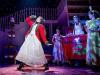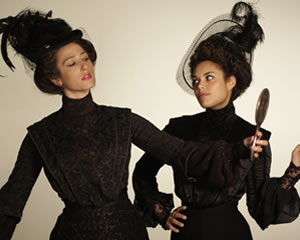
There are a few elements of this production which are good – such as the excellent costumes by Teresa Negroponte – yet the overwhelming sense one gets from the outset is one of befuddlement. One feels compelled to ask: How does one actually go about making an Oscar Wilde comedy almost boring? Worse still: surprisingly unfunny. Indeed, it is very hard to understand how such material could be treated with apparently so little confidence in its strengths.
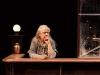
The problems begin from the moment you first see the set. Or rather, the lack thereof. Now, I am not for one moment suggesting that richly-detailed naturalism in set dressing is the only way to go with Wilde – indeed, it would be interesting to see an even more radical departure – but whatever one does it should in some way reflect or reinforce the material, if not the society that is being depicted then at least in some way that is conducive to fostering the sense of wit and frivolity in the piece. Instead we are given an immense white, featureless void that fills the large Parade Theatre stage, populated by isolated pieces of period furniture and actors, all dwarfed by this intensely alienating chasm which seems to suck human emotion out of the scene, especially in its rather flat first act.
Most productions of Earnest I’ve encountered have audiences laughing virtually without interruption from start to finish, a sea of mirth with ebbs and flows but very few moments of calm. In this production, only the very strongest, most supremely arch lines provoked any major laughs, while the bulk of the sharp dialogue seemed to elicit titters, quiet chuckles or even awkward silence.
“Awkward” is a good word for it, actually. This is an altogether awkward production. To have an occasional good line fall flat may be regarded as a misfortune, to let a substantial amount of them do so looks like carelessness…
Rather than letting the lines speak for themselves, the entire cast seems to be attempting to inject as much additional humour via overblown characterisations that verge on caricature, excessive pauses for physical comedy and copious other bits of inserted stage business, all designed to snatch an extra snicker. This was troubling, as it again underscored this seeming lack of faith in the text, almost as though having a predisposition that the play wasn’t adequately funny and needed to scramble in order to try and salvage some laughs.
While this mostly comes through in their performances and off-kilter character choices, it is hard to entirely blame the actors for this. With such a consistency of creative miscalculations in staging, design concept, characterisation, style and pacing, one can really draw few conclusions other than to lay it at the director’s door. Whether Kevin Jackson had some unique insight into the text that prompted this offbeat approach, if these creative directions were motivated by some unifying concept that simply escapes me, I cannot say. But the simple point remains that an undeniably hilarious play came across as frequently dull and awkward. So whatever Jackson may have been attempting sadly failed to bear fruit.
Fortunately though, you can’t completely keep a good play down. Wilde’s evergreen wit shines through, and the production started to regain some ground partway through the second act, almost in spite of itself. By Act Three the outrageous plot (even if you know it backwards) and the brilliant turns of phrase and famous quips (even if you know them by heart) take on a momentum of their own, shrugging off the shackles with which this problematic rendition has bound it. Wilde manages to retrieve something from this in the end, but they certainly didn’t make it easy for him.
Given that this is a production essentially designed to showcase the talents of a graduating class of actors, it seems a poor showcase given the ill-conceived portrayals with which they seem to have been saddled. Kimberly Hews in particular seems misdirected in her approach to Lady Bracknell, coming across as neither intimidating nor particularly amusing, while Hugo Johnstone-Burt’s rather straightforward approach to Jack seems frequently out of step with the rest of the cast’s excesses.
Conversely, if the actors are to largely be excused of blame for their portrayals, it seems churlish to bestow praise on them either. Nevertheless it must be said that Ryan Corr as Algernon and Shari Sebbens as Cecily are particularly good in performances that, although ill-suited to the material, were nevertheless so intrinsically amusing that they deserve something of a special mention.
NIDA’s production of The Importance of Being Earnest is a disappointment, not only after the high bar set by A Journey Through the World of Molière in the same season, but for generally falling short of NIDA’s usual high standards.
NIDA presents
THE IMPORTANCE OF BEING EARNEST
by Oscar Wilde
Directed by Kevin Jackson
Venue: Parade Theatre | 215 Anzac Parade, Kensington
Dates: 31 March - 4 April
Prices: Adult $25 | Concession $15 | Groups 10+ $15
Bookings: 1300 795 012 or www.ticketek.com.au
Info: www.nida.edu.au